
The Artwork

About
The Artist
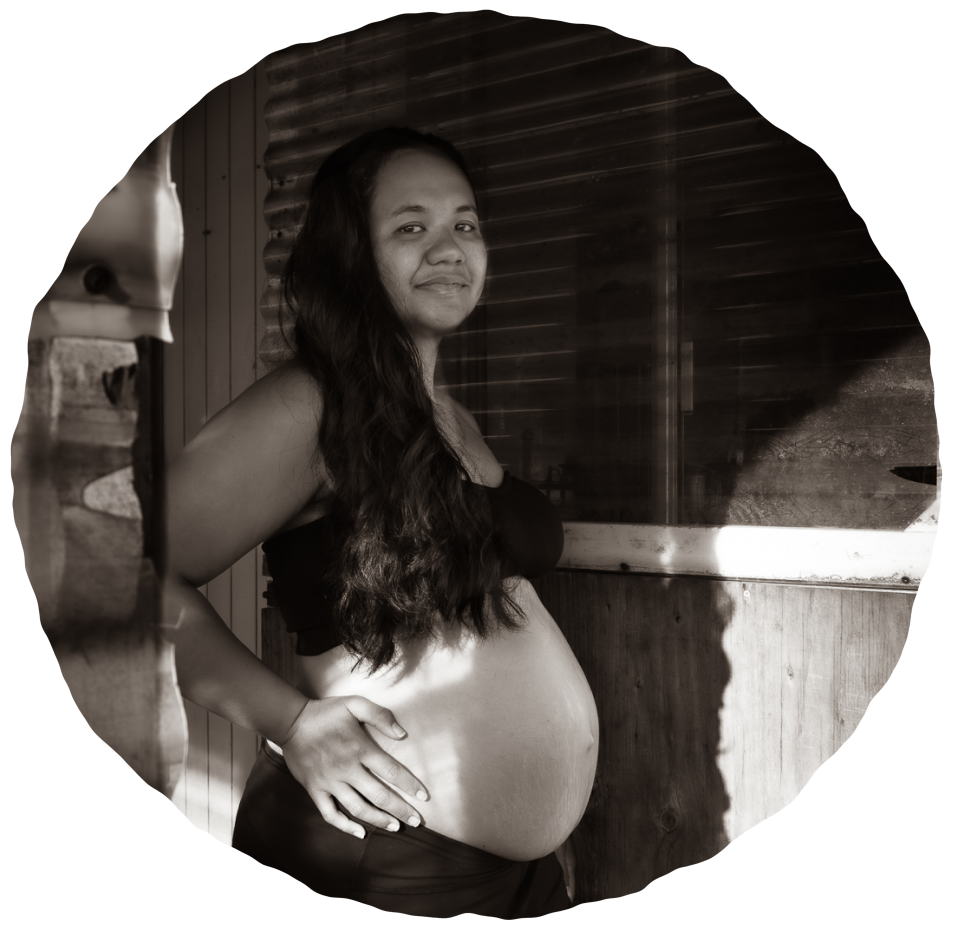
My name is Makaiwa Kanui. My roots are originate in Mauna Huʻihuʻi, ʻŌlaʻa. Mauna Loa, Kīlauaea, and Mauna Kea are my mauna, Waiʻolena is my kai, and the kauakuahine and loloku rains sustain me. I am a wife, mother, artist, musician, community organizer, program planner, grass cutter, and wanna-be farmer.
I come from a family of fish peddlers, and was raised cleaning, and preparing fish for the local community. In my formative years of life I attended kula kaiapuni, and later graduated from Kamehameha Schools. I pursued my Bachelors degree in Studio Art, and a minor in Ethnic Studies from Mills College in Oakland, California in Ohlone Territory. My art is a response to the world, and relationships i hold dear. At times my art is lament, with elements of hope. But ultimately, my art is pule. I seek ways to bridge my art to community, while helping others to articulate their own prayers as a collective. I pray that what I create will help those who engage, strengthen their pilina and listening ears to ʻāina and their soul.
About The Artwork
ʻImi No Ke Ēwe o ka ʻĀina
Makaiwa Kanui
Digital painting
April 2026
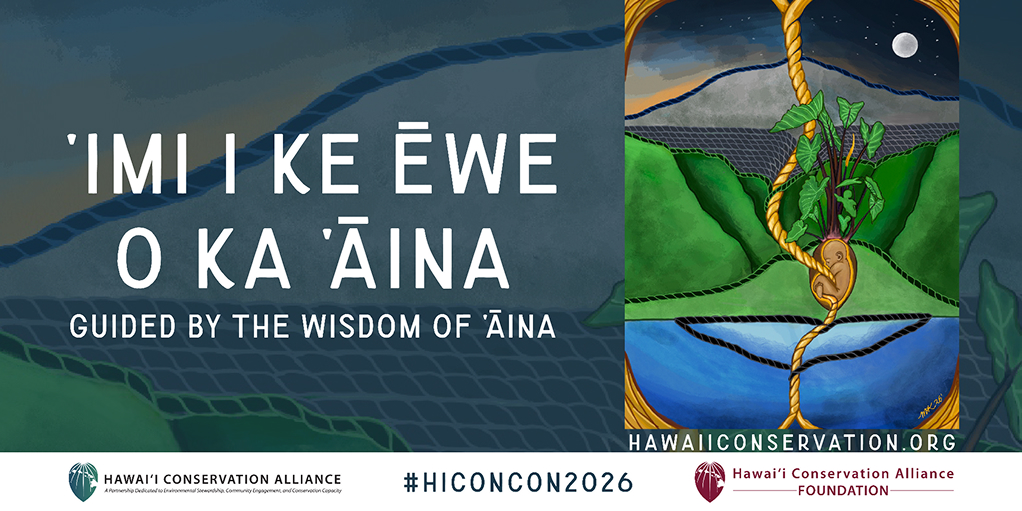
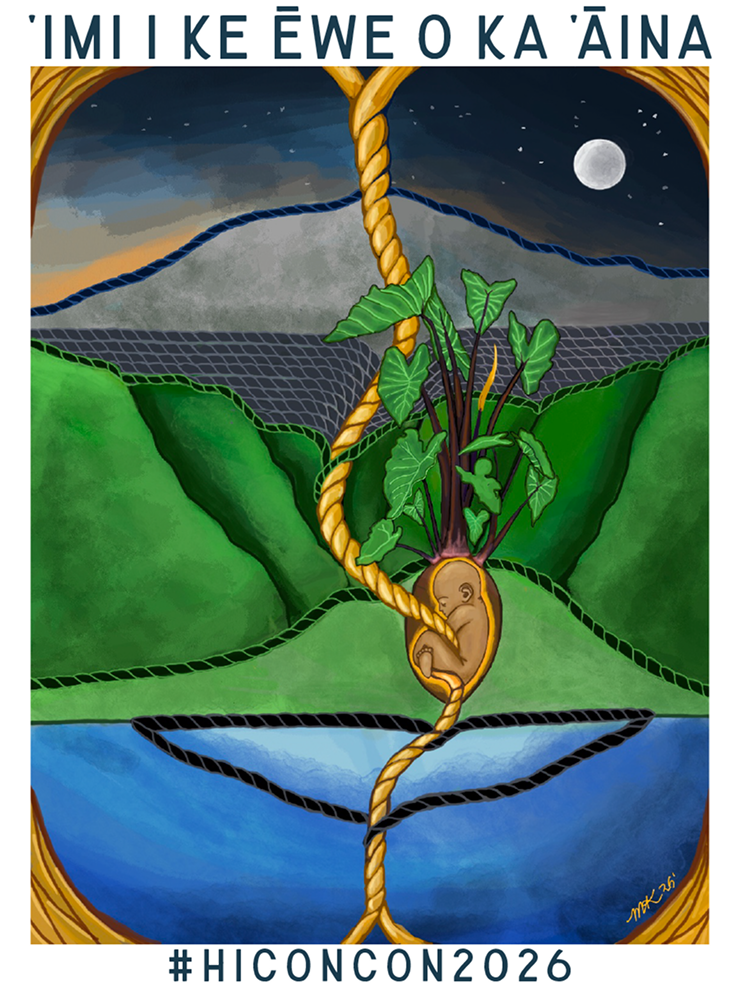
Through pule and thoughtful intention, I offer this image for this yearʻs 2026 Hawaiʻi Conservation Conference in response to the theme: Imi No Ke Ēwe o ka ʻĀina. Iʻve grown very fond of this artwork. Much of the imagery relates to the pregnancy of creation, and as I was creating this, my body was carrying my third child in its third trimester. I feel personally connected to this piece and the meaning that it carries. I am honored to have this opportunity to capture not just an image, or a concept, but also a pule for the next generation of ‘āina and Aloha ʻĀina.
The lauloa varieties of kalo are poetically referred to as hāloa, characterized by “long stalks” or “long leaves.” The Lauloa ʻEleʻele ʻUla is depicted with its red-lined kōhina at the base and ʻeleʻele “purple-black” hā, whose lihi “edges” have an ʻula “pinkish” coloration. The cultivation of this variety of kalo today continues to be a loving reminder that we are descendants of this kūpuna kalo and of the land that feeds us.
We see the ēwe (umbilical cord) embedded and outlined throughout the painting from ma uka to ma kai. In the different wao (regions) represented, we see ēwe being woven into the central ēwe, representing unlimited connections. As we reflect on our relationship to Hāloa there is a sense that we as kānaka are a part of this bigger ʻohana. The ēwe of the land connects us to our kūpuna (ancestors). We learn from them, we are guided by them, we are fed by them, and we are sustained by them. Where do you see yourself in this image?
The central ēwe connecting to Hāloa has no ending or beginning. At the top and bottom, you see that the umbilical cord continues to be woven in the celestial realm and in the depth of Moananuiākea. As the cordage gets bigger toward the edge of the frame, there is a sense that we are moving beyond the two-dimensional into our lived reality. Our world is a part of this imagery and a part of this moʻolelo that continues to be woven from the past, into the present, and on to the future. The rounded edges implies the hōnua is also within the embryonic.
We see rapid decline of kūpuna species throughout our paeʻāina, with many at the brink of extinction. We have witnessed and experienced much loss in the habitats that we steward, in our workplace, communities, and families. There is grief in seeing so much transition. We see Ao turning into Pō; and yet ʻāina teaches us that there is new life that comes out of pō, the place of the embryonic and limitless potentiality. This image shows us that in this time of transition, we can also hold onto the hope that there is goodness being birthed, although our eyes cannot see it just yet. We believe and pule for the best that is yet to come. And we do not give up in doing the good work we are called to do.
Conference: Hawaiʻi Conservation Conference 2026
Theme: ʻImi i ke ʻEwe o ka ʻĀina — Guided by the Wisdom of ʻĀina
Medium: Digital Painting
Artist: Makaiwa Kanui
Year: 2026
The conference artwork is more than a decorative element. It acts as a visual anchor for this year’s gathering — helping express the story, emotion, and intention behind the conference theme.
As participants come together to learn, share, and collaborate, this artwork reminds us that the future of conservation in Hawaiʻi is shaped by both knowledge and relationship: the science we practice, the communities we serve, and the ʻāina that continues to guide us.