
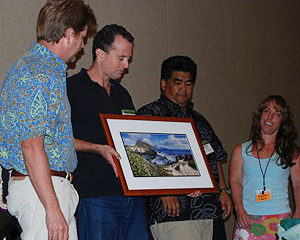
 U.S. Fish and Wildlife Service Conservation Partnership Program
Craig Rowland, Chris Swenson, Benton Kealii Pang, and Adonia HenryThis award is given to the instigators or champions of a procedure that leads to significant advances to the structure or nature of environmental conservation in Hawai‘i. Examples of such procedure may be the creating of legislation that changes the dynamics of management, or programs that lead to significant better protection of the Hawai’i’s native ecosystems.
The mission statement of the Conservation Partnerships Program is “to restore and protect native habitats by developing positive relationships with landowners, identifying biological resources and threats, implementing projects, monitoring results, and sharing information.”
The Conservation Partnerships Program is comprised of the following:
- Partners for Fish and Wildlife – Cost-sharing and technical assistance for long-term habitat restoration projects on private land;
- Pacific Islands Coastal Program – A new effort to identify important coastal resource problems and solutions, develop partnerships to carry out on-the-ground conservation projects, and encourage community action in high priority coastal areas;
- Private Stewardship Grants – A focused effort to address high-priority habitat restoration needs of species that are endangered, threatened, candidates or species of concern on private lands; and
- Other Funding – The Conservation Partnerships Program has been able to obtain funding from various other USFWS programs for a number of partnership programs. This program has taken a unique and highly effective approach of combining resources in order to focus on collaborative efforts that conserve or restore large portions of ecosystems while still addressing species-specific conservation. The program completed over $6 million in restoration and conservation projects in the last two years alone, including The North Kona Dryland Forest Restoration Group, The Ola‘a-Kīlauea Partnership, Imi pono no ka ‘āina: A Partnership for Environmental Education, Maui Restoration Group (Auwahi) and Pu‘uokali Wiliwili Forest Reserve Project, and Leeward Haleakalā Restoration Watershed Restoration Partnership.
Student Awards
Each year at the conference, the HCA awards prizes to the top student oral and poster presenters. Monetary awards were sponsored by the Hawai’i Conservation Alliance and The Wildlife Society-Hawai’i Chapter.
Best Student Oral Presentation:
Luc Leblanc
Assessment of Non-Target Insect Attraction to Fruit Fly (Tephritidae) Male Lures on Hawai‘i and Maui Islands
Luc Leblanc1, Daniel Rubinoff1, Roger Vargas2
1University of Hawai‘i, CTAHR-PEPS, Honolulu, HI, 2USDA-ARS, PBARC, Hilo, HI
Successful integrated pest management emphasizes the use of environmentally less toxic control methods for agricultural pests. However, it is possible that some of these more desirable methods may have unanticipated non-target impacts. Field investigations were conducted to assess the possible attraction to fruit fly (Tephritidae) male lures along ecological gradients ranging from native, mixed and secondary forests to agricultural farmlands and residential areas. Traps baited with male lures (cue-lure and methyl eugenol) were maintained and emptied weekly at 35 sites along three transects on Hawai‘i Island and 46 sites in native forest and in persimmon and coffee orchards on Maui Island, during the 2005 and 2006 summer seasons, respectively. Trap catches were compared to catches by unbaited control traps. Male lures failed to attract insects other than target fruit flies, except for a weak honeybee and syrphid fly attraction and fungus gnat (Sciaridae) attraction to methyl eugenol. Non-targets were abundant only in male lure traps with large accumulations of dead trapped fruit flies, giving a false impression of lure attraction. Numerous native species were collected at traps artificially baited with decaying fruit flies in native and adjacent mixed forest, but only non-native species were attracted to traps set up in invasive forest, orchards, farmlands and backyards. Traps did not attract beneficial predatory or parasitoid insects. Fruit fly lures are therefore environmentally safe when used in orchards, and their registration process is underway to make them available to fruit growers.
Runner-up:
William Haines
Rethinking Extinctions: Conservation Status of Hawaiian Leafroller Moths in the Genus Omiodes (Crambidae)
William Haines, Cynthia King, Daniel Rubinoff
University of Hawai‘i Department of Plant and Environmental Protection Sciences, Honolulu, HI
Partly because the genus Omiodes (formerly Hedylepta) contains the only native Hawaiian insects to be specifically targeted by biological control programs, the conservation status of this group has been of interest to entomologists, conservation biologists, and agriculturalists. Due to suspected pressures of biological control agents, accidentally introduced parasitoids and predators, and habitat destruction, 14 of the 23 Hawaiian species have been listed as extinct since the 1980s. To better understand current distributions and conservation status of Omiodes and other Hawaiian Lepidoptera, we have conducted light trapping and host plant surveys on most of the Hawaiian Islands, and have discovered populations of at least 6 “extinct” species. Several species formerly listed as extinct, such as O. continuatalis and O. monogona, are actually widespread. Other species, such as O. asaphombra and O. anastreptoides, have a more restricted range. Yet others, such as O. epicentra and O. telegrapha, have not been recorded for a hundred years, and are likely to be extinct. Controlled exposure trials have also been completed to assess actual parasitism rates in populations of some of the rediscovered species. Systematic analyses of molecular data shed further light on the evolutionary significance of certain populations, suggesting that some morphotypes described as distinct species may be color variants of other species. Our findings highlight the value of focused surveys and phylogenetic analyses when identifying threatened populations of insects and other cryptic organisms.
Best Student Poster Presentation:
Meris Bantilan-Smith
A Quantitative Investigation and Inventory of the Soils and Vegetation of Coastal Lowland Hawaiian Wetlands
Meris Bantilan-Smith1, Greg Bruland1, Rich MacKenzie2, Christina McGuire3, Adonia Henry4, Connie Ramsey5
1University of Hawai‘i at Mānoa, Honolulu, HI, 2Institute of Pacific Island Forestry, U.S. Forest Service, Hilo, HI, 3Pacific Coast Joint Venture, Honolulu, HI, 4U.S. Fish and Wildlife Service, Honolulu, HI, 5U.S. Army Corps of Engineers, Honolulu, HI
Coastal lowland wetlands are important features in the landscape that provide numerous functions for people and wildlife, including water quality improvement, flood attenuation, wildlife habitat, and biological productivity. Due to the loss and degradation of wetlands throughout the Hawaiian Islands, created (CWs) and restored (RWs) wetland projects are becoming more common. A comprehensive, quantitative assessment of the conditions of these wetlands has yet to occur and it has not been resolved whether CWs and RWs provide the same environmental and ecological benefits as NWs. In light of this deficiency this project seeks to assess the current water quality and habitat functions of CWs, RWs, and semi-natural wetlands in Hawai‘i. Approximately 40 coastal wetlands sites on each of the five major Hawaiian Islands (Kaua‘i, O‘ahu, Moloka‘i, Maui, and Hawai‘i) were intensively sampled. The sampling consisted of collecting soil samples and assessing percent cover of vegetation across two transects that spanned the major hydrologic gradients at each site. Preliminary results revealed that vegetation communities were dominated by exotic, invasive species and that there were significant differences in soil across the hydrologic gradients and among the different types of sites. Soil samples and vegetation data will be further analyzed to evaluate whether the water quality and habitat functions performed by the different wetland types significantly differ between wetland types and among different islands.
Runner Up:
Frances Kinslow
Fungal Colonization of Leaf Litter from Native and Invasive Riparian Trees in Forested and Developed River Reaches on the Island of Hawai‘i
Frances Kinslow1, Richard Mackenzie2, Nicole Cormier2
1University of Hawa‘i at Hilo, Hilo, HI, 2USDA Forest Service IPIF, Hilo, HI
Breakdown of inedible compounds in decaying leaf matter in freshwater systems is attributed to the action of fungal processing. In continental systems, this conditioning is the initial step in a food web for shredders and other organisms. However, Hawai‘i lacks many of the detrital invertebrates typically found in stream communities, making fungal colonization the primary factor in breakdown of leaf litter. Concentrations of ergosterol, a steroid unique to fungal cells, was measured from leaf litter in the Wailuku River on the Big Island to directly quantify fungal colonization, providing us with the first data set ever to consider the role fungal colonies play in leaf litter breakdown in Hawaiian streams. Fungal biomass and decomposition rates were compared between senesced leaves from the dominant native canopy tree Metrosideros polymorpha (‘ōhi‘a) and the common invasive N-fixer Falcataria moluccana (albizia), in an impacted site in a developed area and a relatively non-impacted forest site along the Wailuku during wet and dry seasons in 2005 and 2006. Preliminary results show no difference between sites. However, although over time fungal colonization on ‘ōhi‘a leaves eventually matched or exceeded that of albizia, albizia was found to have significantly higher initial fungal biomass and subsequently, a more rapid rate of decomposition. Substantial inputs of albizia to freshwater streams in Hawai‘i has the potential to dramatically alter the dynamics of the stream community by aiding in the establishment of introduced exotics, and increasing nitrogen levels in Hawaiian rivers and their downstream coastal areas.