
Poster Gallery
Poster Presentations Gallery
Use this space to view poster presentations for the 2021 Hawaiʻi Conservation Conference. Posters are listed by abstract number in ascending order. Please note that you will have a chance to talk with poster authors during our Poster Session on Thursday July 29th from 11:00 AM – 12:00 PM. Click the “Join Now” button next to “Poster Session” on the agenda. The presenter will be at a virtual table labelled with their abstract number and name.
- Poster #8 - Kaili Kosaka & Koki Atcheson
- Poster #11 - Nancy Matsumoto
- Poster #24 - L. Kalaʻi Ellis
- Poster #30 - Derek Ford
- Poster #33 - Becca Lensing
- Poster #34 - Matthew Sandrich
- Poster #54 - Olivia Wang
- Poster #86 - Lilly Thomey
- Poster #89 - Ellyn Bitume
- Poster #93 - Lupita Ruiz-Jones
- Poster #123 - Joseph Williams-Solomon
- Poster #132 - Kai Mottley
- Poster #155 - Beverly Beebe
- Poster #167 - Olivia Stogner
- Poster #177 - Joanna Philippoff & Florybeth F. La Valle
- Poster #187 - Cathleen Bailey & Annie Marshall (Nēnē Recovery Action Group)
- Poster #210 - Mervyn Tano
- Poster #214 - Springer Kaye
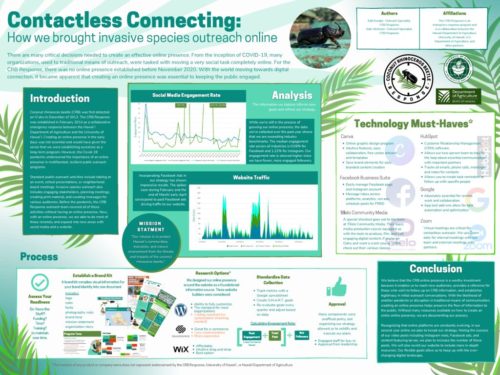
Poster #8: "Contactless Connecting: How We Brought Invasive Species Outreach Online" - Kaili Kosaka & Koki Atcheson
Poster #8
Poster Presenter: Kaili Kosaka & Koki Atcheson
Poster Title: Contactless Connecting: How We Brought Invasive Species Outreach Online
Contact: crbpr1@hawaii.edu
Click the image below to view the poster at a larger size
HCC2021 Poster #8: “Contactless Connecting: How We Brought Invasive Species Outreach Online” – Kaili Kosaka & Koki Atcheson
Poster Authors:
Kaili Kosaka – CRB Response, Honolulu, HI
Koki Atcheson – CRB Response, Honolulu, HI
Abstract
The success of past Coconut Rhinoceros Beetle (CRB) Response outreach activities has relied on in-person events and interactions. What happens when a global pandemic turns the world on its head, significantly limiting in-person communication? The CRB Response, along with countless other organizations, faced this challenge in 2020. Creating an online presence is a daunting task, and with so many options out there, it’s hard to imagine where to begin. Careful consideration and planning helped us to bring our outreach capabilities online. Starting from scratch, we developed a plan and timeline. We utilized business marketing principles of branding to guide the development of our website, social media accounts, and print materials. Next, we engaged stakeholders to determine decision making power and studied which metrics to track to indicate success. Bringing it all together, we developed a website as the backbone to support our outreach efforts.
By creating an online presence, we’ve reached more than 500 unique website users in the first three months, maintained a social media engagement rate 100 times greater than the industry benchmark, and continued to engage with our community without having to leave the office.
Our hope in laying out our strategy and considerations is to help others bolster their online presence. With no end in sight to COVID-19, creating an online presence has been vital to keeping us connected to the communities we serve. We hope this poster can serve as a guide for other organizations working to build their online brand.
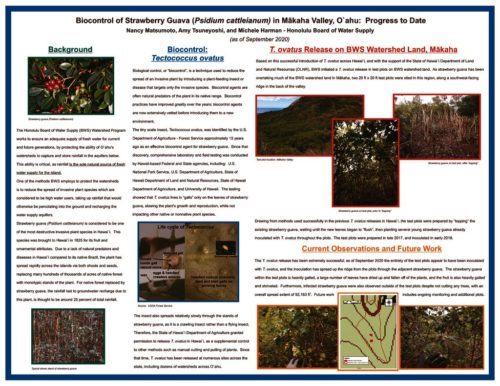
Poster #11: "Biocontrol of Strawberry Guava in Mākaha Valley, O`ahu: Progress to Date" - Nancy Matsumoto
Poster #11
Poster Presenter: Nancy Matsumoto
Poster Title: Biocontrol of Strawberry Guava in Mākaha Valley, O`ahu: Progress to Date
Contact: nmatsumoto@hbws.org
Click the image below to view the poster at a larger size
HCC2021 Poster #11: “Biocontrol of Strawberry Guava in Mākaha Valley, O`ahu: Progress to Date” – Nancy Matsumoto
Poster Authors:
Nancy Matsumoto – Honolulu Board of Water Supply, Honolulu, Hawaii
Amy Tsuneyoshi – Honolulu Board of Water Supply, Honolulu, Hawaii
Michele Harman – Honolulu Board of Water Supply, Honolulu, Hawaii
Abstract
The Honolulu Board of Water Supply (BWS) Watershed Program works to ensure an adequate supply of fresh water for current and future generations, by protecting the ability of O`ahu’s watersheds to capture and store rainfall in the aquifers below. This ability is critical, as rainfall is the sole natural source of fresh water supply for the island. One of the methods BWS employs to protect the watersheds is to reduce the spread of invasive plant species which are considered to be high water users, taking up rainfall that would otherwise be percolating into the ground and recharging the water supply aquifers. Strawberry guava (Psidium cattleianum) is considered to be one of the most destructive, water-intensive invasive plant species in Hawai`i. Accordingly, BWS established two 20-foot by 20-foot pilot test plots for the biocontrol (scale insect) Tectococus ovatus on watershed land invaded by strawberry guava in Mākaha Valley. Since inoculating the test plots, field surveys have confirmed the biocontrol has spread successfully throughout and well beyond the boundaries of the plots into the invaded forest, to an estimated total extent of 52,163 square feet. Future work includes ongoing monitoring and additional test plots.
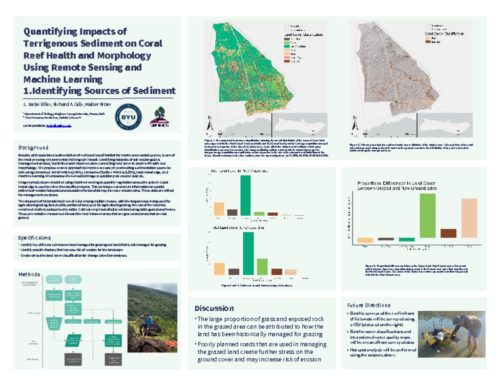
Poster #24: "Quantifying Impacts of Terrigenous Sediment on Coral Reef Health and Morphology Using Remote Sensing and Machine Learning" - L. Kalai Ellis
Poster #24
Poster Presenter: L. Kalai Ellis
Poster Title: Quantifying Impacts of Terrigenous Sediment on Coral Reef Health and Morphology Using Remote Sensing and Machine Learning
Contact: ellis.kalai@gmail.com
Click the image below to view the poster at a larger size
 HCC2021 Poster #24: “Quantifying Impacts of Terrigenous Sediment on Coral Reef Health and Morphology Using Remote Sensing and Machine Learning” – L. Kalai Ellis
Poster Authors:
Logan Ellis – Brigham Young University, Provo, Utah
Richard Gill – Brigham Young University, Provo, Utah
Walter Ritte – ʻĀina Momona, Hoʻolehua, Hawaii
Abstract
Erosion, with associated sedimentation of reefs and loss of habitat for marine and coastal species, is one of the most pressing environmental challenges in Hawaii. Identifying hotspots of soil erosion guides management on land, but limited work has been done connecting land cover to coral reef health and morphology. Current reef survey methods overgeneralize the spatial variation of benthic cover and sediment deposition. We propose a novel approach to improve accuracy by connecting sedimentation source to sink using Unmanned Aerial Vehicles (UAVs), Unmanned Surface Vehicles (USVs), local knowledge, and machine learning. UAVs can capture images to create 3-D orthomosaics of the terrestrial system while USVs can be used to create 3-D coral reef models. Models are classified using machine learning to quantify vegetation across the system. Community knowledge is used to refine the classified models, providing land managers with geographic information system (GIS) layers that specify areas of high concern for conservation. This technique can provide information on spatial patterns of erosion hotspots, benthic cover types, reef morphologies, reef health, water temperatures, and water turbidity. These data are critical for management decisions. We showcase a test of this approach at the Kaʻamola ahupuaʻa on Molokaʻi where local insights and imagery are used to improve conservation planning. Here we present the terrestrial image acquisition and analysis with marine data acquisition to be performed in Summer 2021. This approach is widely applicable across Hawaii and the Pacific and will lead to better management of watershed-coral reef ecosystems.
Poster #30: "Applications of Drone Data for Science, Conservation and Education: Examples from Hawai'i and Antarctica" - Derek Ford
Poster #30
Poster Presenter: Derek Ford
Poster Title: Applications of Drone Data for Science, Conservation and Education: Examples from Hawai’i and Antarctica
Contact: islanduav@gmail.com
Click the image below to view the poster at a larger size
HCC2021 Poster #30: “Applications of Drone Data for Science, Conservation and Education: Examples from Hawai’i and Antarctica” – Derek Ford
Poster Authors:
Derek Ford – University of Hawaii at Manoa, Honolulu, HI & Island UAV LLC, Waipahu, HI
Abstract
This poster presents three case studies which demonstrate a variety of drone data analysis techniques for science, conservation and educational purposes. Firstly is a study on tree species mapping in the Pupukea forest reserve using drone data and deep learning. In this study three classification algorithms were tested for identifying five dominant plant species or family of species. Highest overall accuracy of 71% was achieved, and African Tulip was identified with 95% accuracy. This study is presented as an example of how accurately and to what level of detail tree species can be affordably mapped within a dense mixed forest setting in Hawai‘i. Secondly is an analysis of land cover and surface temperature in Antarctic moss banks using visible light, near-infrared (NIR) and thermal-infrared (TIR) data collected from a multi-sensor drone. It was found that vegetated surfaces get warmer than non-vegetated surfaces under sunny conditions. This study showcases two drone data analysis techniques in particular: the use of normalized difference vegetation index (NDVI) for vegetation mapping, and modeling solar radiation from the drone-derived DEM. This study also demonstrates the versatility of drones and miniaturized sensors. Thirdly is an educational exercise involving school campus surface hydrology mapping conducted by high school students using drone data and ArcGIS. Within this exercise students learned how to use a drone-derived digital elevation model (DEM) to create surface flow accumulation models and identify important areas on campus for water retention features. This case study demonstrates the educational potential of drones for science and conservation.
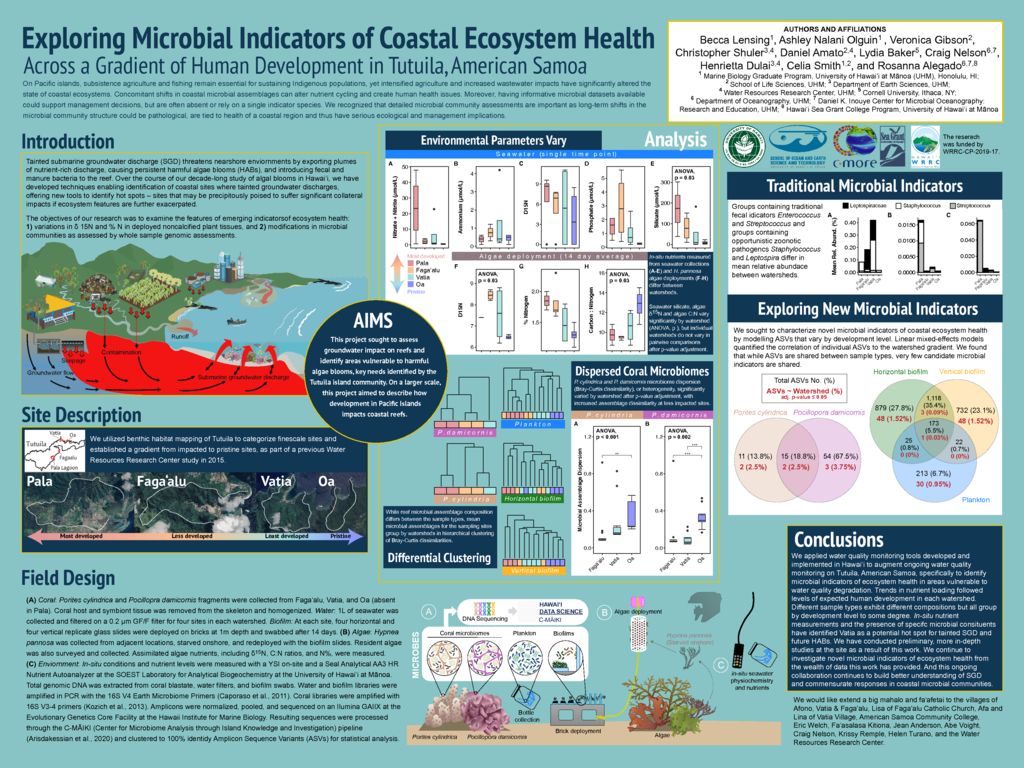
Poster #33: "Exploring Microbial Indicators of Coastal Ecosystem Health Across a Gradient of Human Development in Tutuila, American Samoa" - Becca Lensing
Poster #33
Poster Presenter: Becca Lensing
Poster Title: Exploring Microbial Indicators of Coastal Ecosystem Health Across a Gradient of Human Development in Tutuila, American Samoa
Contact: blensing@hawaii.edu
Click the image below to view the poster at a larger size
 HCC2021 Poster #33: “Exploring Microbial Indicators of Coastal Ecosystem Health Across a Gradient of Human Development in Tutuila, American Samoa” – Becca Lensing
Poster Authors:
Becca Lensing – Marine Biology Graduate Program, University of Hawaiʻi at Mānoa, Honolulu, HI
Ashley Nalani Olguin – Marine Biology Graduate Program, University of Hawaiʻi at Mānoa, Honolulu, HI
Veronica Gibson – School of Life Sciences, University of Hawaiʻi at Mānoa, Honolulu, HI
Christopher Shuler – Department of Earth Sciences, University of Hawaiʻi at Mānoa, Honolulu, HI & Water Resources Research Center, University of Hawaiʻi at Mānoa, Honolulu, HI
Daniel Amato – School of Life Sciences, University of Hawaiʻi at Mānoa, Honolulu, HI & Water Resources Research Center, University of Hawaiʻi at Mānoa, Honolulu, HI
Lydia Baker – Cornell University, Ithaca, NY
Craig Nelson – Department of Oceanography, University of Hawaiʻi at Mānoa, Honolulu, HI & Daniel K. Inouye Center for Microbial Oceanography: Research and Education, University of Hawaiʻi at Mānoa, Honolulu, HI
Henrietta Dulai – Department of Earth Sciences, University of Hawaiʻi at Mānoa, Honolulu, HI & Water Resources Research Center, University of Hawaiʻi at Mānoa, Honolulu, HI
Celia Smith – Marine Biology Graduate Program, University of Hawaiʻi at Mānoa, Honolulu, HI & School of Life Sciences, University of Hawaiʻi at Mānoa, Honolulu, HI
Rosanna Alegado – Department of Oceanography, University of Hawaiʻi at Mānoa, Honolulu, HI & Daniel K. Inouye Center for Microbial Oceanography: Research and Education, University of Hawaiʻi at Mānoa, Honolulu, HI
Abstract
On Pacific islands, subsistence agriculture and fishing remain essential for sustaining Indigenous populations, yet intensified agriculture and increased wastewater impacts have significantly altered the state of coastal ecosystems. Concomitant shifts in coastal microbial assemblages can alter nutrient cycling and create human health issues. Moreover, having informative microbial datasets available could support management decisions, but are often absent or rely on a single indicator species. Our primary objective was to apply water quality monitoring tools developed and implemented in the Hawaiian Islands to augment ongoing water quality monitoring on Tutuila, American Samoa, specifically identifying microbial indicators of ecosystem health in areas vulnerable to water quality degradation. We genetically surveyed microbial assemblages from coastal water, biofilms, and two coral species from four watersheds on Tutuila, across a gradient of development levels. Sample type efficiency and bias in environmental monitoring were evaluated and identified critical links between coastal water quality and microbial assemblages among development levels. Microbial indicators of development level were identified in all sample types. Results showed higher than expected nitrogen levels at a semi-pristine site, possibly representing a critical hot spot for anthropogenic change, and all sample types differentiated between development levels but with varying patterns and clarity. This work supports existing monitoring and assessment projects to integrate a diverse array of biological and physical datasets into a decision-making framework. This multi-dimensional study has enabled a better understanding of commensurate responses in coastal microbial assemblages that will inform future methodologies and aid resource managers in on-going monitoring of coastal ecosystems.
Poster #34: "Initial Success of Reintroduction Efforts for the Orangeblack Hawaiian Damselfly (Megalagrion xanthomelas) on Oʻahu" - Matthew Sandrich
Poster #34
Poster Presenter: Matthew Sandrich
Poster Title: Initial Success of Reintroduction Efforts for the Orangeblack Hawaiian Damselfly (Megalagrion xanthomelas) on Oʻahu
Contact: mvsandrich@gmail.com
Click the image below to view the poster at a larger size
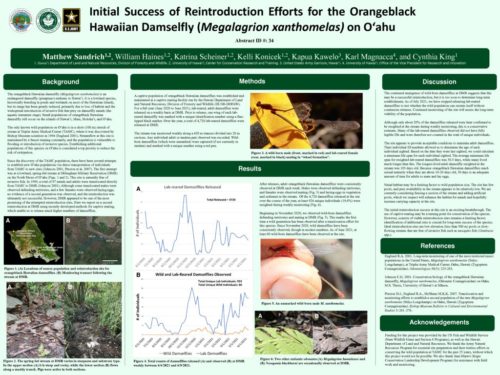
HCC2021 Poster #34: “Initial Success of Reintroduction Efforts for the Orangeblack Hawaiian Damselfly (Megalagrion xanthomelas) on Oʻahu” – Matthew Sandrich
Poster Authors:
- Matthew Sandrich – Department of Land and Natural Resources, Division of Forestry and Wildlife, Honolulu, HI & University of Hawaii, Center for Conservation Research and Training, Honolulu, HI
- William Haines – Department of Land and Natural Resources, Division of Forestry and Wildlife, Honolulu, HI & University of Hawaii, Center for Conservation Research and Training, Honolulu, HI
- Katrina Scheiner – Department of Land and Natural Resources, Division of Forestry and Wildlife, Honolulu, HI & University of Hawaii, Center for Conservation Research and Training, Honolulu, HI
- Kelli Konicek – Department of Land and Natural Resources, Division of Forestry and Wildlife, Honolulu, HI & University of Hawaii, Center for Conservation Research and Training, Honolulu, HI
- Momi Pearlman – Department of Land and Natural Resources, Division of Forestry and Wildlife, Honolulu, HI & University of Hawaii, Center for Conservation Research and Training, Honolulu, HI
- Karl Magnacca – University of Hawaii, Office of the Vice President for Research and Innovation, Honolulu, Hawaii
- Kapua Kawelo – United States Army Garrison, Hawaii, Honolulu, HI
- Cynthia King – Department of Land and Natural Resources, Division of Forestry and Wildlife, Honolulu, HI
Abstract
The orangeblack Hawaiian damselfly (Megalagrion xanthomelas) is an endangered, endemic Hawaiian damselfly (pinapinao) with small populations on Oʻahu, Molokaʻi, Maui, and Hawaiʻi Island. Nonnative fish are a primary cause of decline of this species. On Oʻahu, there is a single known wild population at the Tripler Army Medical Center. In 2018, the Hawaiʻi Invertebrate Program (HIP) began a captive rearing and reintroduction program for M. xanthomelas. Reintroductions of captive-reared naiads were attempted at both Lyon Arboretum and Waiʻanae Kai Forest Reserve in 2019 but were ultimately unsuccessful. In June 2020, HIP and the Army’s Natural Resources Program began weekly M. xanthomelas releases at Dillingham Military Reservation (DMR). The selected site, a 420 m stretch of a spring-fed, fish-free stream, was the target of an unsuccessful attempt to translocate wild-caught damselflies in 1999. As of February 2021, over 3,000 captive-reared adult damselflies, marked with individual ID numbers for tracking, have been released at DMR. Weekly monitoring of the stream revealed continual use by released damselflies, including mating and egg-laying. In November 2020, wild-born, adult M. xanthomelas were observed at the stream, marking the first documented wild-born generation of M. xanthomelas after a reintroduction attempt. Damselflies from the wild generation were captured and marked with unique ID numbers, and new wild-born individuals continue to emerge weekly. The completion of a wild generation represents an exciting milestone in preventing extinction of M. xanthomelas, but continued monitoring is needed to assess the long term establishment of this new wild population.
Poster #54: "Nest Site Characteristics of Pueo (Asio flammeus sandwichensis) on O‘ahu" - Olivia Wang
Poster #54
Poster Presenter:
Poster Title: Nest Site Characteristics of Pueo (Asio flammeus sandwichensis) on O‘ahu
Contact: Olivia Wang
Click the image below to view the poster at a larger size
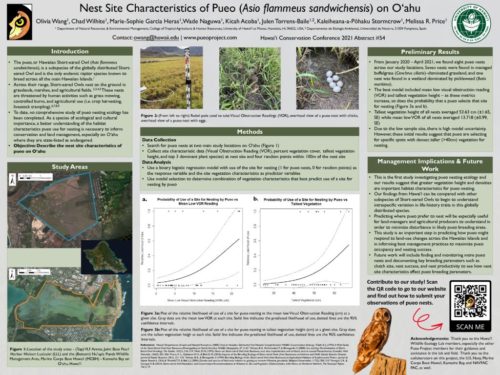
HCC2021 Poster #54: “Nest Site Characteristics of Pueo (Asio flammeus sandwichensis) on O‘ahu” – Olivia Wang
Poster Authors:
Olivia Wang – University of Hawai‘i at Mānoa, Honolulu, HI
Chad Wilhite – University of Hawai‘i at Mānoa, Honolulu, HI
Julen Torrens-Baile – University of Hawai‘i at Mānoa, Honolulu, HI
Kaleiheana-a-Pōhaku Stormcrow – University of Hawai‘i at Mānoa, Honolulu, HI
Marie-Sophie Garcia-Heras – University of Hawai‘i at Mānoa, Honolulu, HI
Melissa Price – University of Hawai‘i at Mānoa, Honolulu, HI
Abstract
The Hawaiian Short-eared Owl (Asio flammeus sandwichensis), or pueo, is the only endemic raptor species known to breed across all the main Hawaiian Islands. As a species of ecological and cultural importance, understanding the habitat characteristics pueo use for nesting is necessary to inform conservation, especially on O‘ahu where they are state-listed as endangered. In this study we assessed nest-site characteristics of 8 pueo nests found during the 2020 and 2021 breeding seasons at two sites at the Lualualei Navel Annex in Wai‘anae, and the Nu‘upia Ponds at Marine Corps Base Hawaii—Kaneohe Bay, O‘ahu. We collected nest-site characteristics including the percent cover, maximum vegetation height, and visual obstruction reading (VOR) at nest sites and at four randomly selected points within 100 meters. Seven nests were found in managed non-native grassland (dominant plant species: buffelgrass (Cenchrus ciliaris)) and one was found in a wetland (dominant plant species: pickleweed (Batis maritima)). Vegetation height at the nests ranged from 0.43 to 0.55 meters tall, and percent cover ranged from 65% to 98%. A logistic regression model using site characteristics as covariates was used to identify site characteristics that best predict the probability of use as a nest site. We found that pueo preferred to nest in sites with taller and denser vegetation than expected if nests were randomly placed throughout the habitat. This study is an important step in understanding vegetation characteristics that can be promoted through conservation actions to maximize pueo occupancy and nesting success in Hawai‘i.
Poster #86: "Developing an Alternative, Lab-Based Diet for Hawaiian Ground Snails – Food Preference Research and Nutrient Analyses" - Lilly Thomey
Poster #86
Poster Presenter: Lilly Thomey
Poster Title: Developing an Alternative, Lab-Based Diet for Hawaiian Ground Snails – Food Preference Research and Nutrient Analyses
Contact: thomeylilly96@gmail.com
Click the image below to view the poster at a larger size
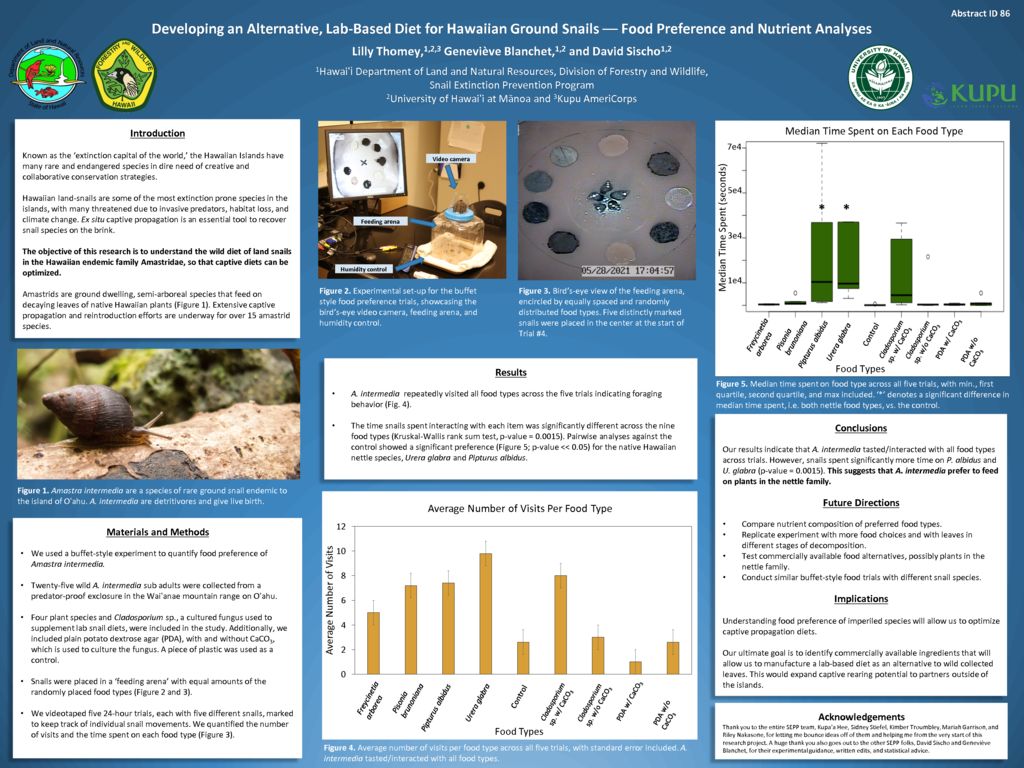
HCC2021 Poster #86: “Developing an Alternative, Lab-Based Diet for Hawaiian Ground Snails – Food Preference Research and Nutrient Analyses” – Lilly Thomey
Poster Authors:
Lilly Thomey – Hawai’i’s DLNR – Division of Forestry and Wildlife, Snail Extinction Prevention Program, Honolulu, Hawai’i & Kupu Conservation Leadership Development Program, AmeriCorps Service Member, Honolulu, Hawai’i
Geneviève Blanchet – Hawai’i’s DLNR – Division of Forestry and Wildlife, Snail Extinction Prevention Program, Honolulu, Hawai’i
David Sischo – Hawai’i’s DLNR – Division of Forestry and Wildlife, Snail Extinction Prevention Program, Honolulu, Hawai’i
Abstract
Many rare and endangered species rely on captive propagation to prevent extinction. Understanding an organism’s natural diet and associated foraging behavior is critical to diet replication in a lab environment. Terrestrial snail species of the Hawaiian Islands face many threats, including invasive predators, habitat loss, and climate change. Ex situ captive rearing programs, like Hawai’i’s Snail Extinction Prevention Program (SEPP), are essential for keeping these native snail species from the brink of extinction. Amastridae is an endemic family of imperiled ground and semi-arboreal snail species that feed on decaying leaves of native plants including, but not limited to, māmaki (Pipturus albidus), ūpuhe (Urera glabra), and ʻieʻie (Freycinetia arborea). Currently, rearing amastrid species is restricted to the islands due to their reliance on wild-collected native plant material for food. The objective of this research is to develop an alternative, lab-based diet that will meet the nutritional needs of amastrid species. We performed buffet style feeding trials with Amastra intermedia individuals to quantify the type and proportion of preferred food items. Next, we sent preferred food material off for nutrient analyses. Using the results of the nutrient analyses, we identified commercially available ingredients to compose alternative manufactured diets. Results of our feeding trials and nutrient analyses will be presented, as well as suggestions for future diet research. An effective manufactured diet for Amastridae would enable the expansion of captive rearing efforts to participating partners outside of the state, significantly increasing the potential for conservation.
Poster #89: "Exploration of Potential Biological Control Agents for Albizia (Falcataria moluccana) in its Native Range" - Ellyn Bitume
Poster #89
Poster Presenter: Ellyn Bitume
Poster Title: Exploration of Potential Biological Control Agents for Albizia (Falcataria moluccana) in its Native Range
Contact: ellyn.bitume@usda.gov
Click the image below to view the poster at a larger size
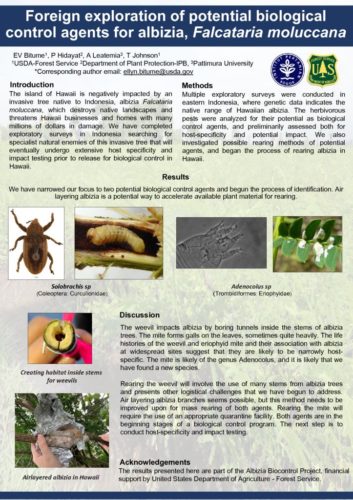
HCC2021 Poster #89: “Exploration of Potential Biological Control Agents for Albizia (Falcataria moluccana) in its Native Range” – Ellyn Bitume
Poster Authors:
Ellyn Bitume – United States Forest Service, Hilo, HI
Purnama Hidayat – Institut Pertanian Bogor, Bogor, Indonesia
Audrey Leatemia – Pattimura University, Ambon, Indonesia
Tracy Johnson – United States Forest Service, Hilo, HI
Abstract
Classical biological control refers to the intentional introduction of a natural enemy from the native range of an invasive species into the presumably enemy-free space of the invaded range. The objective of biocontrol is for introduced agents to establish permanently and provide long-term suppression of an invasive species and the restoration of ecological balance. The island of Hawaiʻi is negatively impacted by an invasive tree native to Indonesia, albizia Falcataria moluccana, which destroys native landscapes and threatens Hawaiʻi businesses and homes with many millions of dollars in damage. We have completed exploratory surveys in Indonesia searching for specialist natural enemies of this invasive tree that will eventually undergo extensive host specificity and impact testing prior to release in Hawaiʻi. Two high priority candidates for further study include gall forming eriophyid mites and a stem boring weevil. Also among early prospects is a rust fungus (Uromycladium falcatarium) that galls new growth and is a major problem for albizia plantations in the Philippines and Indonesia. Here we discuss the biological control process, describe the potential agents, and discuss the next steps in our international collaboration with researchers in Indonesia to find and evaluate appropriate natural enemies of albizia.
Poster #93: "Reef Health in Maunalua Bay" - Lupita Ruiz-Jones
Poster #93
Poster Presenter: Lupita Ruiz-Jones
Poster Title: Investigating the Spatial Patterning of Coral Relatedness Across an Urban Reef Environment
Contact: guadalupe.ruiz-jones@chaminade.edu
Click the image below to view the poster at a larger size
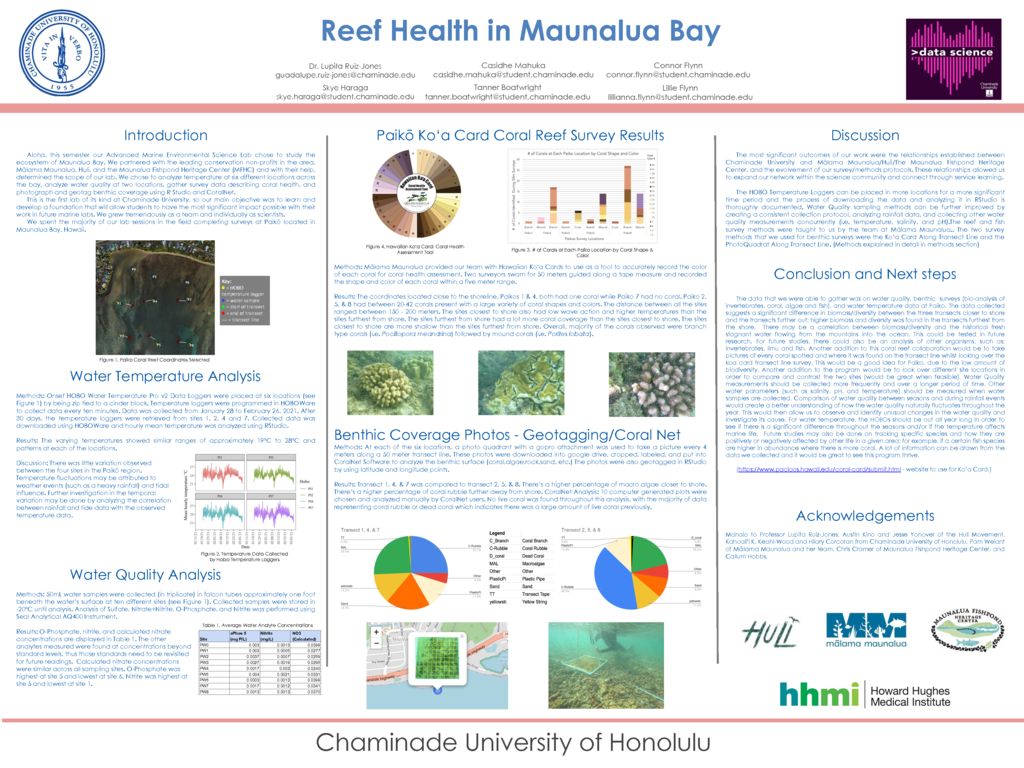
HCC2021 Poster #93: “Reef Health in Maunalua Bay” – Lupita Ruiz-Jones
Poster Authors:
Lupita Ruiz-Jones – Chaminade University of Honolulu, Honolulu, HI
Skye Haraga – Chaminade University of Honolulu, Honolulu, HI
Casidhe Mahuka – Chaminade University of Honolulu, Honolulu, HI
Tanner Boatwright – Chaminade University of Honolulu, Honolulu, HI
Lillie Flynn – Chaminade University of Honolulu, Honolulu, HI
Connor Flynn – Chaminade University of Honolulu, Honolulu, HI
Abstract
Kaneohe Bay is Hawaii’s largest bay and home to several of the most abundant reef-building coral species found across the Main Hawaiian Islands. The bay has historically been heavily impacted by anthropogenic sources, such as dredging, input of sewage, and invasive algae. In contemporary times, the bay is regularly frequented by fishers and tourists. Kaneohe Bay is also a spatially heterogenous mosaic, making it an ideal place to examine the association between genotypic diversity, phenotypic variation, and environment across space. During the recent global bleaching event variation in individual response was observed within species and adjacent colonies. Despite these various stressors, coral abundance in the bay remains relatively high compared to nearby reefs, especially on the south shore. These spatially heterogenous mosaics might be useful sources of corals for restoration. Data on genotype uniqueness when selecting reef restoration stock helps to preserve genetic diversity. In our study we seek to gain insight into how environmental conditions influence population structure and persistence of specific genotypes of Montipora capitata, a potential restoration species. Using temperature loggers, sedimentation traps, and water flow meters, we characterized 30 sites and systematically sampled 600 colonies across the bay. With reduced representation genome sequencing we are investigating relatedness. We are developing a seascape map with genetic, phenotypic, and environmental information that can assist in understanding the relationship between the three.
Poster #123: "Shifting the Balance in Lowland Mesic Forests" - Joseph Williams-Solomon
Poster #123
Poster Presenter: Joseph Williams-Solomon
Poster Title: Shifting the Balance in Lowland Mesic Forests
Contact: jkws@hawaii.edu
Click the image below to view the poster at a larger size
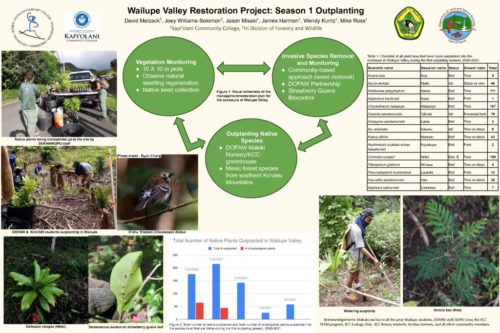 HCC2021 Poster #123: “Shifting the Balance in Lowland Mesic Forests” – Joseph Williams-Solomon
Poster Authors:
Michael Ross – Kapiolani Community College, Honolulu, Hawaiʻi
Joseph Williams-Solomon – Kapiolani Community College, Honolulu, Hawaiʻi
Abstract
The Wailupe Valley Restoration project is an on-going collaborative effort between Kapi‘olani Community College (KCC) and the State of Hawaiʻi, Division of Forestry and Wildlife (DOFAW), to help restore a 5-hectare fenced exclosure in Wailupe Valley, Oʻahu. The fenced exclosure was built by DOFAW in 2014 to remove herbivore ingress, primarily feral pigs, and to protect habitat for the endangered ʻElepaio (Chasiempis ibidis), which is an endemic bird that nests in the area. During the first phase of the project, vegetation monitoring and invasive species removal efforts were employed, and regeneration of native seedlings was shown to occur. However, despite the natural regeneration of native seedlings, the overall native plant species diversity is still quite low at the site. Therefore, in the second phase of the project efforts are being focused on outplanting of native dry and mesic forest plant species. The site has the potential to serve as an important refugia for many rare or endangered native plants from the southern Koʻolau Mountains. Some of the native plant species being outplanted include, Antidesma platyphyllum (hame), Chrysodracon halapepe (halapepe), Ochrosia compta (hōlei), Pittosporum glabrum (hōʻawa), Pneumatopteris hudsoniana (laukahi), and Rauvolfia sandwicensis (hao).
Poster #132: "Developing a Climate Change Refugia Suitability Model for Hawaii's Critical Habitats" - Kai Mottley
Poster #132
Poster Presenter: Kai Mottley
Poster Title: Developing a Climate Change Refugia Suitability Model for Hawaii’s Critical Habitats
Contact: kaimottley@gmail.com
Click the image below to view the poster at a larger size
HCC2021 Poster #132: “Developing a Climate Change Refugia Suitability Model for Hawaii’s Critical Habitats” – Kai Mottley
Poster Authors:
Kai Mottley – Kauai High School, Lihue, Hawaii
Abstract
A predictive model using Geographic Information Systems (GIS) was developed to (1) determine the impact of sea level rise on Hawaii’s biodiversity, (2) model future “refugia” or protected areas suitable for the relocation of endangered species vulnerable to sea level rise, and (3) also measure the “cost” (in terms of species loss) of delayed conservation action to establish refugia. This project is a continuation of the research presented at the Hawaii Conservation Conference last year. The model has been expanded with additional spatial data, more variables (such as elevation and moisture data), and also includes five (4) sea level rise scenarios. Also new is the inclusion of an analysis to determine species loss due to delayed action.
Poster #155: "Impact of Marine Debris on Whales and Dolphins in Hawaiʻi" - Beverly Beebe
Poster #155
Poster Presenter: Beverly Beebe
Poster Title: An Introduction to the Impact of Marine Debris on Whales and Dolphins in Hawaiʻi
Contact: beebev@earthlink.net
Click the image below to view the poster at a larger size
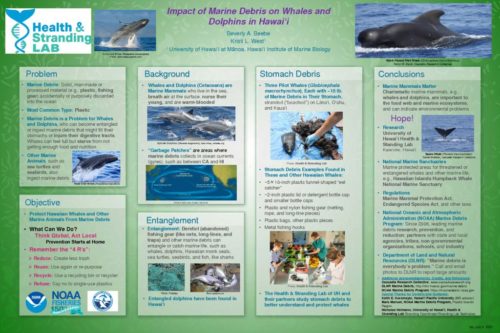 HCC2021 Poster #155: “An Introduction to the Impact of Marine Debris on Whales and Dolphins in Hawaiʻi” – Beverly Beebe
Poster Authors:
Beverly Beebe – University of Hawaiʻi Health and Stranding Lab, Kāne‘ohe, Hawaii
Kristi L. West – University of Hawai‘i at Mānoa, Hawai‘i Institute of Marine Biology
Abstract
The University of Hawaiʻi Health and Stranding Lab is authorized by the National Oceanic and Atmospheric Administration (NOAA) and works with cultural practitioners to respond to strandings and collect remains of stranded Pacific whales and dolphins. At their Kāne‘ohe Bay lab, whale and dolphin necropsies are done and samples, sometimes including ingested food and marine debris, are processed, recorded, and stored. Briefly, marine debris is persistent solid material manufactured or processed and disposed of or abandoned into the ocean. A NOAA website suggested strandings are important indicators of the population health of cetaceans, apex species that can reveal ocean health. Anthropogenic impacts, like plastic ingestion and entanglement, may be evident at strandings or necropsies. The University of Hawaiʻi Health and Stranding Lab team is studying three short-finned pilot whales (Globicephala macrorhynchus), including one from the October 2017 mass stranding on Kauaʻi. Each individual stranded with about 15 pounds of marine debris in their stomach, “stomach debris,” which is mostly rope, netting, and plastic. Cleaning, filtering, and disentangling or separating stomach debris are labor-intensive and time-consuming processes. Each piece of debris is photographed, measured, and weighed, and other analyses may be performed. The negative effects of cetacean entanglement or debris ingestion can range from discomfort to death, and may include compromised health, gastrointestinal problems or ruptures, a false sense of being full, and starvation. Marine mammal stomach debris highlights human-caused health and conservation concerns. Findings imply that marine debris prevention and removal are important for ocean species and environmental protection.
Poster #167: "Detecting Toxoplasma gondii in the Giant African snail (Lissachatina fulica) in O‘ahu, Hawai‘i" - Olivia Stogner
Poster #167
Poster Presenter: Olivia Stogner
Poster Title: Detecting Toxoplasma gondii in the Giant African snail (Lissachatina fulica) in O‘ahu, Hawai‘i
Contact: lovelifeandliv@gmail.com
Click the image below to view the poster at a larger size
HCC2021 Poster #167: “Detecting Toxoplasma gondii in the Giant African snail (Lissachatina fulica) in O‘ahu, Hawai‘i” – Olivia Stogner
Poster Authors:
- Olivia Stogner – Auburn University, Auburn, Alabama
- Kenneth Hayes – The Bishop Museum, Honolulu, Hawaii
- Christopher Lepczyk – Auburn University, Auburn, Alabama
- Sarah Zohdy – Auburn University, Auburn, Alabama
Abstract
Toxoplasmosis is a parasitic disease to Hawaiʻi caused by the intracellular protozoan Toxoplasma gondii and has fatal impacts on several endangered wildlife species, such as the ʻAlalā (Corvus hawaiiensis) and Īlio-holo-i-ka-uaua (Monachus schauinslandi). Although non-native domestic cats (Felis catus) are the only definitive host for T. gondii in Hawaiʻi, it’s possible for other species to ingest and carry T. gondii oocysts, such as marine snails, though detection of T. gondii oocysts in land snails has not been explored. If land snails carry T. gondii oocysts, this could pose a major threat to wildlife conservation, due to the high number of invasive land snails in Hawaiʻi. To determine if land snails can ingest and carry T. gondii oocysts, we collected fecal samples from 160 Lissachatina fulica from three feral cat congregation sites in Oʻahu. We extracted DNA from a portion of each sample and used nested PCR to detect presence/absence of T. gondii DNA, by amplifying the 529-bp repeat fragment. We will use genetic sequencing to confirm positive samples and light microscopy to examine the presence of T. gondii oocysts in the remaining feces of confirmed samples. Half of the samples have been screened and the remaining samples will be screened by May 2021. Sequencing of positive samples will be complete by June 2021 and microscopy by August 2021. Confirmation of T. gondii in land snail feces would indicate an alternative pathway for Toxoplasmosis infection in wildlife and could have important implications for conservation management and non-native species control.
Poster #177: "Building Undergraduate Knowledge About the Scientific Process through Our Project In Hawai‘i’s Intertidal (OPIHI)" - Joanna Philippoff & Florybeth F. La Valle
Poster #177
Poster Presenter: Joanna Philippoff & Florybeth F. La Valle
Poster Title: Building Undergraduate Knowledge About the Scientific Process through Our Project In Hawai‘i’s Intertidal (OPIHI)
Contact: philippo@hawaii.edu
Click the image below to view the poster at a larger size
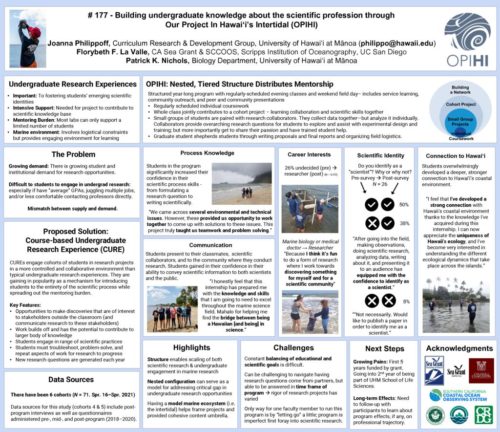
HCC2021 Poster #177: “Building Undergraduate Knowledge About the Scientific Process through Our Project In Hawai‘i’s Intertidal (OPIHI)” – Joanna Philippoff & Florybeth F. La Valle
Poster Authors:
Joanna Philippoff – University of Hawaii at Manoa, Honolulu, HI
Patrick Nichols – University of Hawaii at Manoa, Honolulu, HI
Florybeth F. La Valle – Southern California Coastal Ocean Observing System & CA Sea Gran, San Diego, CA & Scripps Institution of Oceanography University of California, San Diego, San Diego, CA
Abstract
Our Project In Hawai‘i’s Intertidal (OPIHI) is an undergraduate program whose scientific purpose is to characterize the Hawaiian rocky intertidal and nearby subtidal areas to determine if and how they are changing over time. The educational purpose is to enhance scientific literacy skills while providing participants with the training needed to engage in conservation work. Hawai‘i’s intertidal is a culturally important ecosystem susceptible to climate change and land-use practices, but it has been historically understudied due to seasonal wave activity and a narrow tidal range. However, this area is ideal for engaging emerging scientists in research experiences because of the sampling power of trained students. The yearlong program has a nested structure that spreads mentoring responsibilities of students between project facilitators, scientific partners, and collaborating college departments. Project questions are generated and analyzed in collaboration with scientists and community groups—including those in academia, government agencies, and non-profits. Undergraduates are not only exposed to an array of mentors and career pathways, they participate in service learning, including assisting teachers and K–12 students on field trips—thus modeling the next step in the STEM pipeline. OPIHI is transitioning from a grant-funded to an institutionalized program at UHM. This presentation will share results of project assessments, which indicate participants are increasing their knowledge about Hawai‘i’s coastal environment and enhancing their understanding of the scientific process and scientific self-efficacy, lessons learned over six years of OPIHI undergraduates (N = 71), and next steps for the program.
Poster #187: "Downlisting of Nēnē: The Outcome of Research Based Management" - Cathleen Bailey & Annie Marshall (Nēnē Recovery Action Group)
Poster #187
Poster Presenter: Cathleen Bailey & Annie Marshall (Nēnē Recovery Action Group)
Poster Title: Downlisting of Nēnē: The Outcome of Research Based Management
Contact: cathleen_bailey@nps.gov
Click the image below to view the poster at a larger size
HCC2021 Poster #187: “Downlisting of Nēnē: The Outcome of Research Based Management” – Cathleen Bailey & Annie Marshall
Poster Authors:
Cathleen Bailey – Haleakalā National Park, Kula, HI
Annie Marshall – US Fish and Wildlife Service, Ecological Services, Honolulu, HI
Paul Banko – US Geological Survey, Pacific Island Ecosystems Research Center, Hawaii National Park, HI
Stephanie Franklin – Hawai’i Division of Forestry and Wildlife, Kahului, HI
Darcy Hu – National Park Service, Hawaii National Park, HI
Steve Kendall – Hakalau Forest National Wildlife Refuge, Hilo, HI
Bryce Masuda – Hawai‘i Endangered Bird Conservation Program, San Diego Zoo Global, Volcano, HI
Raymond McGuire – Hawai’i Division of Forestry and Wildlife, Hilo, HI
John Medeiros – Hawai’i Division of Forestry and Wildlife, Kahului, HI
Kathleen Misajon – National Park Service, Hawaii National Park, HI
Joy Tamayose – Haleakalā National Park, Kula, HI
Kim Uyehara – Kaua‘i National Wildlife Refuge Complex, Kīlauea, HI
Donna Ball – Hakalau Forest National Wildlife Refuge, Hilo, HI
Clay Chow – Hawai’i Division of Forestry and Wildlife, Lihue, HI
Charlotte Forbes-Perry – Hawai’i Volcanoes National Park, Hawaii National Park, HI
Thomas Kaiakakapu – Hawai’i Division of Forestry and Wildlife, Lihue, HI
Sierra McDaniel – Hawai’i Volcanoes National Park, Hawaii National Park, HI
Joey Mello – Hawai’i Division of Forestry and Wildlife, Hilo, HI
Jason Misaki – Hawai’i Division of Forestry and Wildlife, Honolulu, HI
Afsheen Siddiqi – Hawai’i Division of Forestry and Wildlife, Honolulu, HI
Kanalu Sproat – Hawai’i Division of Forestry and Wildlife, Hilo, HI
Abstract
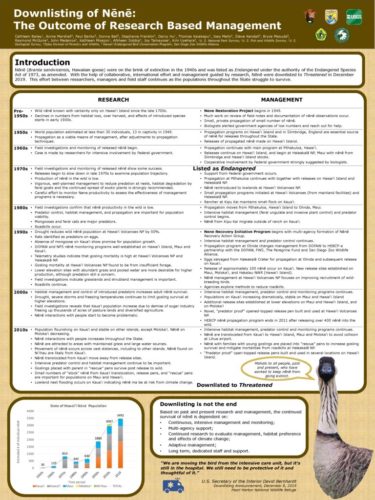
Nēnē (Hawaiian Goose, Branta sandvicensis), the state bird of Hawaiʻi, faced imminent extinction in the 1940s. To recover the species, the Nēnē Restoration Program (NRP) was initiated in 1949 by the State of Hawaiʻi and the U.S. Fish and Wildlife Service to breed and release birds through a conservation breeding program. In 1950, the global population was estimated at only 30 wild individuals. In 1967, nēnē were added to the federal Endangered Species list with approximately 240 birds on Hawaiʻi Island and 39 on Maui. Birds were released through the NRP until the early 1980s. In the early 1990s, the Nene Recovery Action Group (NRAG) formed as an ad hoc group to discuss and implement research and practical management actions to recover nēnē in the wild. Since then, research and management actions implemented by various agencies and private organizations helped increase the population to 3,500 wild individuals on four islands in 2019. Nēnē were federally downlisted from Endangered to Threatened in December 2019 and remains Endangered by the State of Hawai‘i. Since the beginning of the NRP and the formation of the NRAG, researchers and biologists collected and analyzed data on the species that contributed to the decision to downlist the species. This included information on population status and trends, threats, releases, movement, and management actions. We present this information as well as identify future research and management necessary to ensure the continued success and survival of this iconic species.
Poster #210: "Indigenizing Circular Economy Approaches to Sustainable Development Goal 2.5" - Mervyn Tano
Poster #210
Poster Presenter: Mervyn Tano
Poster Title: Indigenizing Circular Economy Approaches to Sustainable Development Goal 2.5
Contact: mervtano@iiirm.org
Click the image below to view the poster at a larger size
HCC2021 Poster #210: “Indigenizing Circular Economy Approaches to Sustainable Development Goal 2.5” – Mervyn Tano
Poster Authors:
Mervyn Tano – IIIRM, Denver, Colorado
Abstract
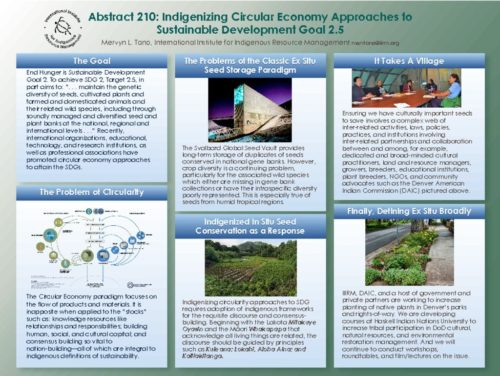
End Hunger is Sustainable Development Goal 2. To achieve SDG 2, Target 2.5, in part aims to: “. . . maintain the genetic diversity of seeds, cultivated plants and farmed and domesticated animals and their related wild species, including through soundly managed and diversified seed and plant banks at the national, regional and international levels . . .” Recently, international organizations, educational, technology, and research institutions, as well as professional associations have promoted circular economy approaches to attain the SDGs.
A circular economy is an economic system of closed loops in which raw materials, components and products lose their value as little as possible, renewable energy sources are used and systems thinking is at the core. We argue the Circular Economy paradigm, with its focus on the flow of products and materials, is inapposite when applied, not to flows but to the “stocks” such as: knowledge resources like relationships and responsibilities; building human, social, and cultural capital; and consensus building so vital to nation-building—all of which are foundational principles of indigenous definitions of sustainability.
We describe the complex web of actors implicated in achieving the ends of SDG-2.5 and suggest consensus-building and discourse guided by principles such as Kuleana (responsibility), Lokahi (unity), Aloha Aina (love and respect for the land and all that dwell on it), Kaitiakitanga (guardianship and protection), and Whakapapa (framework that links all animate and inanimate, known and unknown phenomena in the terrestrial and spiritual worlds) as the first step in indigenizing the circular economy paradigm.
Poster #214: "An Updated Invasive Species Target Selection Procedure for Hawai‘i" - Springer Kaye
Poster #214
Poster Presenter: Springer Kaye
Poster Title: An Updated Invasive Species Target Selection Procedure for Hawai‘i
Contact: skaye@hawaii.edu
Click the image below to view the poster at a larger size
HCC2021 Poster #214: “An Updated Invasive Species Target Selection Procedure for Hawai‘i” – Springer Kaye
Poster Authors:
Springer Kaye – Big Island Invasive Species Committee, Hilo, HI & Pacific Cooperative Studies Unit of the University of Hawaii, Honolulu, HI
James Parker – Big Island Invasive Species Committee, Hilo, HI & Pacific Cooperative Studies Unit of the University of Hawaii, Honolulu, HI
Jonathan Price – Department of Geography and Environmental Studies, University of Hawaii at Hilo, Hilo, HI
Charles Chimera – Pacific Cooperative Studies Unit of the University of Hawaii, Honolulu, HI
Robert Parsons – Big Island Invasive Species Committee, Hilo, HI & Pacific Cooperative Studies Unit of the University of Hawaii, Honolulu, HI
Joel Brunger – Big Island Invasive Species Committee, Hilo, HI & Pacific Cooperative Studies Unit of the University of Hawaii, Honolulu, HI
Kristin Meehan – Big Island Invasive Species Committee, Hilo, HI & Pacific Cooperative Studies Unit of the University of Hawaii, Honolulu, HI
Abstract
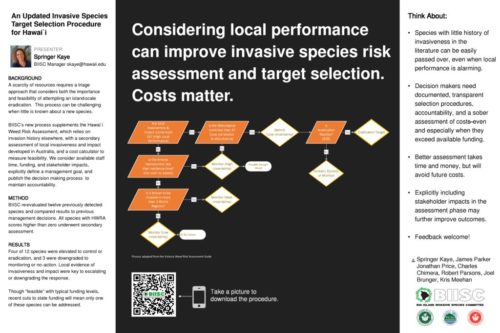
Island-scale eradication of newly detected invasive plants contributes to cost-effective, long-term protection of native biodiversity—when it can be accomplished. A scarcity of resources requires a triage approach that evaluates both the importance and feasibility of attempting an island-scale eradication. Risk assessment tools previously developed in Hawai‘i have primarily relied on a species’ global track record, i.e. the literature, and have contributed to at least thirty successful island-scale eradications of invasive plants. In recent years, however, high-impact pests have arrived without a history of invasion elsewhere, and sometimes without identification! Decision makers need documented, transparent selection procedures, accountability, and a sober assessment of costs—even and especially when they exceed available funding. Our new process supplements the familiar Hawai‘i Weed Risk Assessment tool with a quantitative assessment of local performance developed by the Weeds in the Early Stages of Development project of Victoria, Australia. We added a calculator to estimate the effort required to eradicate the population, and steps to consider available staff time, document the decision-making process and explicitly state the management goal. We evaluated twelve previously detected species and compared results to previous management decisions, which sometimes diverged. This technique still has limitations, and the process requires more investment at the assessment stage, but it may increase the success rate of attempted eradications while boosting transparency and accountability. Similar modifications could be made to the evaluation of other taxa, expanding the scope of risk-assessment tools that rely exclusively on the global track record.